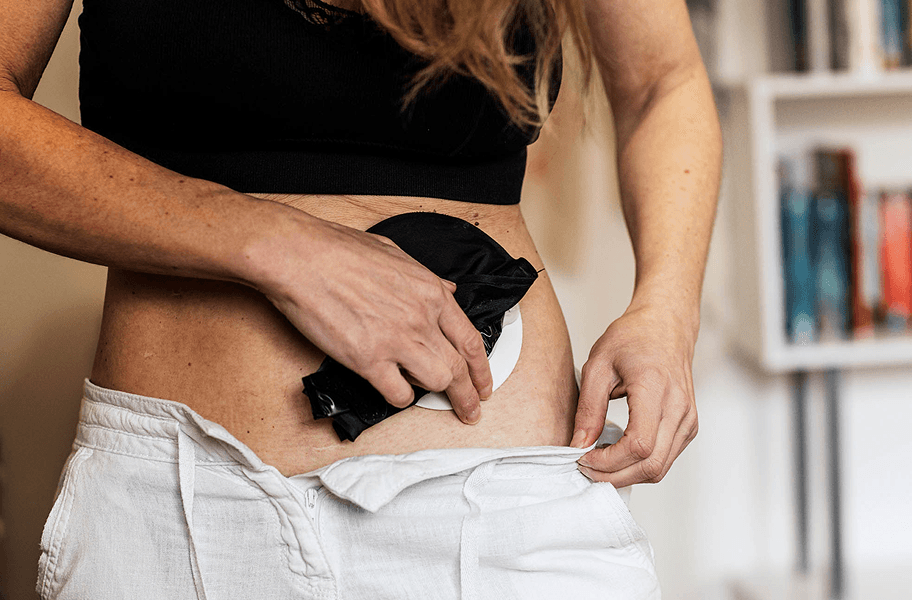
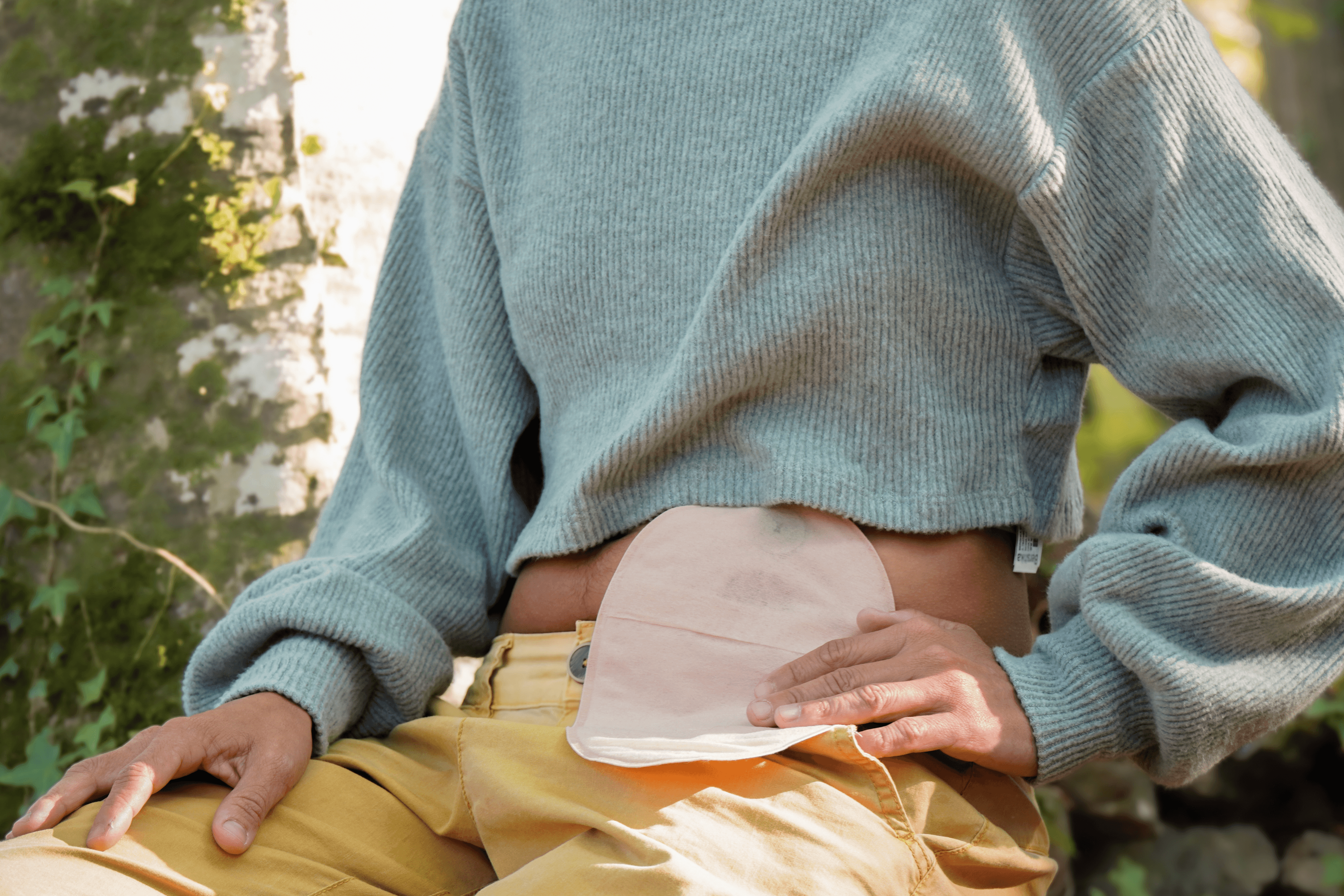
Living with a stoma raises plenty of practical questions, from how often to change your pouch to what to eat and how to sleep comfortably. We asked Sally, a stoma nurse, about the concerns she hears most often, and in this guide she shares her advice on pouch changes, leaks, skin care, diet, sleep, exercise and intimacy.
Sally Wright has worked as a Stoma Care Nurse for over 15 years, providing specialist care, education, and support to individuals recovering from stoma surgery within the community. Sally recognises that every patient’s recovery journey is unique, and she has a particular interest in the psychological aspects of adapting to life with a stoma. Her previous role as a Dermatology Sister highlighted the importance of emotional wellbeing whilst coming to terms with changes to our bodies and the impact on self esteem.
What is normal in the first weeks after stoma surgery, and when should someone call you?
As a stoma nurse, I feel it is important for patients to recognise that we are all unique and our stoma journey including our recovery will be different to the next person. I do tend to remind people to listen to their body after their surgery, rest when you need to as you will be tired for the first few weeks. You need the time and space to recover both mentally and physically. Try to potter around once you are home and make sure you are starting to walk, slowly building up the distance each week.
If you feel low in mood or are still feeling exhausted after the first few months reach out to your stoma care nurse or GP.
How often should a pouch be changed, and how do people know it's time?
You will be able to feel if the pouch is half full as it will feel heavy. Most stoma pouches have a split screen or window at the front where you can see the contents, so if you are unsure and can’t feel the weight of the bag, you can have a look and see what is going on inside.
Closed colostomy pouches will need to be changed after a bowel movement, which is usually once to twice a day. They are sealed so the whole pouch needs to be taken off and disposed of. Whereas ileostomy pouches can stay in place for 24 to 48 hours or even longer if there is still a good seal around the stoma. Unlike the colostomy pouch, these can be drained as they become full, during the day and sometimes overnight. If you notice your output has become loose or you are draining your pouch every few hours, reach out to your stoma nurse to check your output isn’t high or you are not starting to feel dehydrated.
Urostomy pouches again can stay in place for 24 hours or 48 hours. They don’t usually last longer as the urine can start to leak around the stoma and flange area causing itching or irritation. When it comes to draining these pouches, they will need draining frequently throughout the day as the urine flows constantly. They have a tap or a bung so that you easily drain the urine down the toilet.
What are the most common reasons for leaks, and what should people check first?
The most common cause of leaks are down to ill fitting stoma appliances. The first thing I would check is the fit of the baseplate around the stoma to ensure it is fitting well. If it is not, it could be down to the stoma having changed size or shape. The opening could be too small, rubbing or injuring the stoma, or the opening could be too large which could cause irritation and soreness to the exposed skin.
Another good idea is to check their hygiene routine, are they using any fragranced soaps, applying any moisturisers or creams which could prevent the stoma pouch from creating a good seal. Plus, ask yourself questions such as, was the skin completely dry before applying the baseplate? Or has any output got underneath the adhesive, for example.
If there are creases, scars, folds, swelling or a parastomal hernia underneath the baseplate, this could cause issues.
Another thing to check is if pouch was applied correctly or if the backing wasn't completely removed.
Why does the size change in the first weeks? How do you measure a stoma and cut the baseplate to size?
Immediately after surgery the stoma is often swollen (oedematous). Over the following six weeks the postoperative swelling settles and the stoma itself becomes smaller. The abdominal wall is also healing and changing shape, and so any weight loss/gain can affect the fit. At the six weeks point, the swelling will have reduced, and as a stoma care nurse, I would usually see my patients to measure their stoma and help them arrange their stoma pouches cut to the right size.
That's why patients are often measured repeatedly during the early postoperative period rather than being given one permanent template.
If you are measuring your stoma yourself, the best way to measure your stoma is to:
Ask for a measuring guide/template from your delivery company, or measure with a stoma measuring guide from inside your box of stoma pouches.
Start by removing your stoma pouch, so that you can see your stoma fully
Make sure you clean the stoma and surrounding skin with warm water and dry the area thoroughly.
Look at the stoma at the level where it meets the skin.
Measure both width and height as most stomas are not perfectly round.
Transfer that shape onto the baseplate of your stoma product
Use some curved scissors to cut the opening to the measured size/shape.
·Apply this to your stoma to check it fits before you peel off the backing (there should be a 1 mm halo of skin visible around the stoma).
What helps with gas, noise, and odour?
These are common fears for new ostomates and many people ask me “will people hear my stoma as it works?” and “will they be able to smell anything?”. I try and explain to ostomates that wind and noise are normal. A stoma has no sphincter that lets you choose when gas comes out, so it can sometimes make surprisingly loud noises. Gas is often particularly noticeable during the early weeks while the bowel settles down. There are foods and drinks you can avoid to help preventing any excessive gas.
If you feel gas is excessive, make contact with your stoma care nurse.
Things that may help:
Eat slowly and chew food thoroughly.
Eat regularly rather than having very long gaps.
Keep a food diary if particular foods seem to trigger gas.
Fizzy drinks and beer can increase gas
Chewing gum can increase swallowed air.
Some people find onions, garlic, beans, cabbage, cauliflower, broccoli increase gas
Most stoma pouches have a filter designed to release gas and reduce stoma odour.
What is your advice for sleeping with a stoma (positions, avoiding leaks at night, emptying the pouch at night)?
Most people eventually sleep in whatever position is comfortable for them. Often times, people find that sleeping on their back or on the side opposite to their stoma feels more comfortable. By popping a pillow in front of you when you sleep can stop you from rolling onto your stomach, which is a fear from many of my new patients.
Practical things which might help:
Empty the pouch immediately before going to bed.
Make sure the appliance is well adhered before sleeping.
If ballooning is a problem, make sure the filter is functioning.
If output tends to be especially heavy overnight, discuss the pattern with your stoma nurse instead of simply accepting repeated night-time leaks.
Don’t let the pouch become excessively full overnight
If someone is repeatedly waking up because of leaks, that's a reason to review the appliance and stoma, not something they should simply put up with.
Which foods and drinks do patients worry about most, and what do you actually tell them?
This is probably one of the biggest areas which is a source of worry for patients and often I find that people unnecessarily restrict themselves. For most people, the long-term aim is a normal, balanced stoma diet, rather than a permanent list of foods to avoid with a stoma. Immediately after surgery, however, dietary advice can be different while the bowel recovers. Some people are given specific diets from their hospital stoma team and it is important you follow these.
As a stoma nurse I would ensure that those with an ileostomy are watching out for foods which cause them to experience a stoma blockage. Foods which are indigestible such as nuts, sweetcorn, popcorn, mushrooms, hard skins of vegetable and fruits should be avoided. For those with a colostomy or a urostomy, there is slightly more freedom.
My advice would be to introduce foods gradually (one at a time), chew very well, and learn your own response to these foods. Some foods can produce more gas, loosen output, thicken output or, especially with an ileostomy, contribute to blockage risk. But that doesn't mean everyone needs to permanently eliminate them.
Remember that fluids matter particularly with an ileostomy. An ileostomy can produce relatively liquid output, so dehydration is an important concern. Warning signs include thirst, dry mouth, dizziness, weakness and reduced/dark urine. Persistent high or watery output warrants medical advice.
What is normal for the skin around the stoma, and what are signs that something is wrong?
Healthy peristomal skin should look much like the surrounding abdominal skin. The stoma itself is different: it should generally be pink/red, moist and soft, rather like the inside of the mouth. A little bleeding when it is gently cleaned can occur because bowel mucosa is delicate.
Things that aren't normal are persistent redness, soreness or burning, broken/raw skin, weeping, blisters, bleeding that doesn't settle, ulcers, marked itching, recurrent areas of skin damage, or output getting underneath the baseplate.
The most common culprit is often leakage of output onto the skin, but adhesive trauma, frequent appliance removal, allergies and an incorrectly sized template can also contribute.
It is important to note that if the stoma itself becomes purple, dark/black, markedly painful or stops working, that needs urgent medical attention. Speaking of stoma skin care, here's a more comprehensive guide for you.
How can people stay active (exercise, lifting) and lower the risk of a hernia?
A stoma shouldn't mean giving up exercise, exercising with a stoma is completely possible, in fact. After the operation, however, the abdominal wall needs time to heal. The exact restrictions depend on the operation and the surgeon's advice. Once fully recovered, people with stomas can participate in a very wide range of sports. Check with your surgeon when you have your follow up appointment.
A parastomal hernia is a bulge caused by bowel pushing through the abdominal wall around the stoma. Weight, smoking and heavy lifting are among factors associated with risk, although hernias can occur despite doing everything “right.”
How do you talk to patients about intimacy and body image?
A stoma can really affect how we see ourselves, it can affect body image, confidence and sexual relationships, even when everything is medically working perfectly. How we adapt to these body changes are different for each of us. For some patients they are grateful to their stoma for saving their life and for others it is the worst thing which has happened to them. When your body changes it can take time to adapt and accept the new you.
As stoma care nurses we are used to having conversations with our patients about how their stoma affects their sexual relationships, how it might affect intimacy and can help support you with any questions you may have. If you want to read more about dating with a stoma, here's an article for you.
Some tips:
Empty the pouch beforehand before intimacy
Use whatever pouch cover/supportive clothing makes the person feel comfortable
There are some small stoma caps you could try for intimate moment
Try different positions if the stoma or abdomen feels uncomfortable.
Discuss pain, erectile/sexual-function problems or vaginal discomfort with the your GP or surgeon rather than assuming they are “just part of having a stoma.”
A partner may need reassurance and education too.
What are the most common mistakes you see, for example during pouch changes?
Some of the most common ones are surprisingly simple:
Cutting the hole too large - This exposes skin to output and can cause rapid soreness.
Not measuring regularly - Especially early after surgery.
Applying the baseplate to damp skin - Adhesive generally needs a clean, dry surface.
Ripping the old pouch off quickly or not using adhesive remover spray - Repeated trauma can strip the skin.
Using lots of products, especially accessories, “just in case.” - More products don't necessarily mean better adhesion; inappropriate or excessive accessories can actually complicate pouching.
Don't compare your stoma to somebody else's. There is enormous variation in shape, position, output and abdominal anatomy
Just because your friend/neighbour has a certain pouch, might not mean it is necessarily suitable for you
Get help early. Stoma nurses are there because fitting an appliance isn't always straightforward.
Learning the routine takes time. Being frightened or clumsy with the pouch at first doesn't mean you'll always feel that way.
And perhaps the most important one: The goal isn't to become an expert in stoma care overnight. The goal is to gradually reach the point where the stoma becomes one part of your routine, rather than the centre of your life.
Bottom line
Every stoma journey is different, and it takes time to feel confident with your routine. If something doesn’t feel right, such as repeated leaks, sore skin or worries about your output, reach out to your stoma care nurse or GP early. Help is always there, and you don’t need to put up with problems.
If you’d like to explore products designed to support a secure, comfortable fit, take a look at our ostomy products.
FAQ: Living with a stoma
How often should I change my stoma pouch?
This depends on the type of stoma. Closed colostomy pouches are changed after a bowel movement, usually once or twice a day. Ileostomy pouches can stay in place for 24 to 48 hours, or longer if the seal is still good, and are drained as they fill. Urostomy pouches can usually stay on for 24 to 48 hours and need draining frequently, as urine flows constantly.
What are the most common causes of stoma pouch leaks?
The most common cause is an ill-fitting appliance, so check the fit of the baseplate around your stoma first. Other causes include skin that wasn’t completely dry, creams or fragranced soaps that interfere with the seal, creases or scars under the baseplate, and a backing that wasn’t fully removed. If leaks keep happening, ask your stoma nurse to review your appliance.
Why does my stoma change size after surgery?
Right after surgery, the stoma is usually swollen. Over the following six weeks the swelling settles and the stoma becomes smaller. Weight loss or gain can also affect the fit, which is why your stoma is often measured more than once in the early weeks.
What can help with wind, noise and odour?
Wind and noise are normal, as a stoma has no sphincter to control when wind passes. Eating slowly, chewing well, eating regularly and keeping a food diary can all help. Fizzy drinks, beer and chewing gum may increase wind, and most pouches have a filter to release wind and reduce odour.
How should I sleep with a stoma?
Most people sleep in whatever position is comfortable, often on their back or on the side opposite the stoma. A pillow in front of you can stop you rolling onto your stomach. Empty your pouch before bed and check it is well attached. If you’re often woken by leaks, speak to your stoma nurse.
Do I have to follow a strict diet with a stoma?
For most people, the long-term aim is a normal, balanced diet. Introduce new foods one at a time, chew well and see how you react. People with an ileostomy should watch out for hard-to-digest foods that can cause a blockage, and should pay particular attention to drinking enough fluids.
What should the skin around my stoma look like?
Healthy skin should look much like the skin around it. The stoma itself should generally be pink or red, moist and soft. Persistent redness, soreness, raw or weeping skin, blisters or bleeding that doesn’t settle are signs that something is wrong. If the stoma turns purple, dark or black, becomes very painful or stops working, seek urgent medical attention.
Can I exercise with a stoma?
A stoma doesn’t mean giving up exercise. The abdominal wall needs time to heal after surgery, so ask your surgeon at your follow-up appointment what’s right for you. Once you’ve fully recovered, you can take part in a wide range of sports. Avoiding heavy lifting and not smoking are among the factors linked to a lower risk of a parastomal hernia.
Stoma nurse insights: Myths and realities about common ostomy concerns
Myths about living with a stoma still cause unnecessary stigma and anxiety; even though modern stoma care allows people to live full, active lives. Sally Wright sees these misconceptions often, and here she sets the record straight.
Choosing your first stoma appliance can feel overwhelming, especially with so many pouching systems, sizes, and accessories to consider. There's no single "perfect" bag — the right one depends on your stoma, body, and lifestyle, and finding it often takes some trial and adjustment. This guide covers the basics to help you feel more prepared.
Finding the right stoma bag: Everything you need to know
With so many options in shape, size, material and design, choosing the right stoma bag can feel overwhelming at first. But finding the perfect stoma bag isn't about picking the "best" product overall — it's about finding what suits your stoma type and your day-to-day life. In this guide, you'll learn everything you need to know about the different types of stoma bags, how to find the right one for you, and answers to the most common questions.