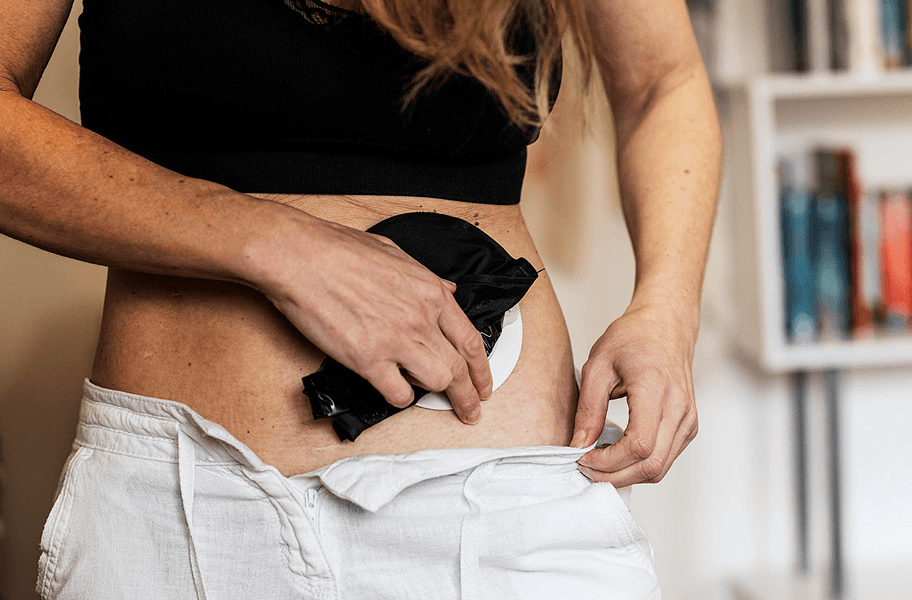
Choosing your first stoma appliance can feel overwhelming, especially with so many pouching systems, sizes, and accessories to consider. There's no single "perfect" bag — the right one depends on your stoma, body, and lifestyle, and finding it often takes some trial and adjustment. This guide covers the basics to help you feel more prepared.
Sally Wright has worked as a Stoma Care Nurse for over 15 years, providing specialist care, education, and support to individuals recovering from stoma surgery within the community. Sally recognises that every patient’s recovery journey is unique, and she has a particular interest in the psychological aspects of adapting to life with a stoma. Her previous role as a Dermatology Sister highlighted the importance of emotional wellbeing whilst coming to terms with changes to our bodies and the impact on self esteem.
What is a stoma appliance?
A stoma appliance is sometimes called a stoma pouch/bag. It is designed to collect output from your stoma.
The type of stoma you have will influence the kind of appliance you may need. The three main types are:
Colostomy: Created from the large intestine, or colon.
Ileostomy: Created from the small intestine, or ileum.
Urostomy: Created to allow urine to leave the body through a stoma.
Although the stoma appliances perform the same basic function, collecting output safely and securely, they are available in many different designs.
Your stoma care nurse will usually help you choose and fit your first appliance. As you become more familiar with your stoma, you may decide to try other options to find the system that suits you best.
Different stoma appliance types
Drainable, closed, or urostomy pouches
The type of pouch you use will usually depend on the type of stoma you have and the consistency or type of output.
Drainable pouches: Have an opening at the bottom that allows the contents to be emptied. They are commonly used by people with an ileostomy who have a looser output and occasionally by some people with a colostomy. E.g: Drainable Standard Alginate by Unora
Closed pouches: Do not have an opening for emptying. Instead, the entire pouch is removed and replaced when needed. They are suitable for a more formed to semi-solid output. E.g.: Closed Standard Alginate by Unora
Urostomy pouches: Are specifically designed to collect urine. They usually have a tap or drainage bung at the bottom and can be connected to a larger drainage bag overnight.
Your stoma care nurse can explain which type is most appropriate for your individual needs.
One-piece or two-piece: what’s the difference?
An important decision is whether to use a one-piece or two-piece system.
One-piece system: with a one-piece system, the adhesive baseplate (flange) and pouch are joined together as a single unit. The entire appliance is removed and replaced at the same time. Some people prefer one-piece systems because they can be simple to use, flexible, and discreet under clothing.
Two-piece system: with a two-piece system, the baseplate (flange) attaches to the skin around the stoma, and the pouch connects separately. This allows you to change the pouch without necessarily removing the baseplate (flange) each time. Some people like the flexibility this offers, although the system may feel slightly different or more noticeable depending on the product.
Neither option is automatically better. Your choice may depend on comfort, dexterity, skin sensitivity, lifestyle, and personal preference.
Flat or convex baseplates
You may also hear the terms flat and convex when discussing ostomy appliances.
A flat baseplate sits relatively flat against the skin and may work well when the stoma protrudes above the skin and the surrounding area is fairly even.
A convex baseplate has a curved shape designed to apply gentle pressure around the stoma. It may help in certain situations, such as when a stoma sits flush with or below skin level. E.g.: Closed Standard Alginate Soft Convex by Unora
Convexity is not something everyone needs, and there are different depths and styles available. It is best to discuss this with a stoma care nurse, particularly if you are newly diagnosed or experiencing leakage.
Ostomy appliances: How to get the fit right
A good fit is one of the most important parts of choosing and using a stoma appliance.
The opening in the baseplate should fit snuggly around your stoma without pressing against it. If too much skin is exposed, your output can come into contact with the skin and cause irritation. If the opening is too tight, it may rub against or injure the stoma.
In the 6 weeks following surgery, your stoma will change in size and shape as the internal swelling reduces. This means you may need to measure your stoma regularly and adjust the opening of your appliance yourself, with guidance from your stoma care nurse.
When you reach 6-8 weeks the swelling has usually fully reduced and your stoma will usually remain this size. This is a good time to get your stoma measured by your stoma nurse and the opening of your stoma pouch can then be cut to fit for you by your delivery company.
What to consider before you choose your first ostomy appliance
Consider your body shape
Everybody is different, and the area around your stoma can affect how an appliance fits.
Factors that may influence your choice include:
Skin folds or creases
Scars
The position and shape of the stoma
Whether the stoma protrudes or sits close to skin level
Changes in body shape when sitting, standing, or moving
An appliance that works well for one person may not work in the same way for another. This is why individual fitting and trying different products can be so important.
Think about your lifestyle
Your ostomy appliance should support your daily life rather than unnecessarily restrict it. When considering different options, think about the activities that matter to you. This might include work, exercise, swimming, travel, sleep, clothing, or caring for children.
Do I feel confident wearing it during exercise or other activities?
Is the drain easy for me to open and close?
Can I manage the appliance comfortably with my level of hand strength or dexterity?
Protect the skin around your stoma
The skin around your stoma, known as the peristomal skin should ideally look and feel similar to the skin elsewhere on your abdomen.
Persistent redness, soreness, broken skin, itching, or discomfort should not simply be accepted as a normal part of living with a stoma. These symptoms may indicate leakage, an issue with fit, sensitivity to a product, or another problem that needs attention.
A well-fitting appliance is an important part of protecting your skin. Additional products such as barrier rings, seals, powders, sprays, or adhesive removers may sometimes be helpful, but not everyone needs every accessory.
Using more products does not necessarily mean better protection. Your stoma care nurse can help you decide what is appropriate for your needs.
Leaks are a sign to review the fit of your stoma appliance
Occasional problems can happen, particularly while you are learning how to manage your ostomy. However, frequent stoma leakage should not be something you simply have to put up with.
Repeated leaks may be related to the fit of the appliance, changes in your stoma or body shape, the condition of the surrounding skin, or the way the appliance is being applied.
If leaks are happening regularly, contact your stoma care nurse for advice. A small adjustment to the fit or a different product may make a significant difference
Trying samples can help
Many ostomy product manufacturers offer samples, giving you the opportunity to try different pouching systems before deciding what works best for you.
When trying a new appliance, consider:
Comfort on your skin
Ease of application and removal
How well the backing plate (flange) secures to your skin
How the pouch feels as it fills
Ease of emptying
How your skin looks when the appliance is removed
How it performs during normal daily activities
It can be helpful to change one thing at a time. If you try several new products or accessories at once, it may be difficult to know what made a positive or negative difference.
FAQ: Your first ostomy appliance
What is a stoma appliance?
A stoma appliance, also called a stoma bag or pouch, is designed to collect output from your stoma safely and securely. The type you need depends on whether you have a colostomy, ileostomy, or urostomy.
What's the difference between drainable, closed, and urostomy pouches?
Drainable pouches have an opening at the bottom for emptying and are commonly used with ileostomies. Closed pouches have no opening and are removed and replaced whole, suiting more formed output. Urostomy pouches are designed specifically to collect urine and usually include a tap or drainage bung.
Should I choose a one-piece or two-piece system?
Neither is automatically better — it depends on comfort, dexterity, skin sensitivity, and lifestyle. One-piece systems combine the baseplate and pouch as a single unit, while two-piece systems let you change the pouch without removing the baseplate each time.
How do I know if my appliance fits properly?
The baseplate opening should sit snugly around your stoma without pressing against it. Your stoma will change size and shape in the first 6 weeks after surgery, so regular measuring and adjustment is normal during this time.
What's the difference between flat and convex baseplates?
A flat baseplate sits evenly against the skin and suits a stoma that protrudes with an even surrounding area. A convex baseplate applies gentle pressure around the stoma and may help if the stoma sits flush with or below skin level.
Will my first appliance be the one I use long term?
Not necessarily. Your stoma and body may change during recovery, and many people try different products over time to find what suits them best. Changing appliances isn't a sign that anything went wrong.
What should I do if I keep experiencing leaks?
Occasional issues are normal while you're learning, but frequent leaks shouldn't be something you simply live with. Contact your stoma care nurse, as a small adjustment to fit or product may resolve it.
Finding the right stoma bag: Everything you need to know
With so many options in shape, size, material and design, choosing the right stoma bag can feel overwhelming at first. But finding the perfect stoma bag isn't about picking the "best" product overall — it's about finding what suits your stoma type and your day-to-day life. In this guide, you'll learn everything you need to know about the different types of stoma bags, how to find the right one for you, and answers to the most common questions.
Stoma prolapse, retraction and stenosis: Early warning signs and clinical management
Stoma prolapse, retraction, and stenosis are common complications that can affect the quality of life for individuals with a stoma. Each condition has its own set of causes, symptoms and ways of managing the complications. Understanding the early warning signs is important for you to maintain comfort and health with a your stoma. Contact with your Stoma Care Nurse who can help address issues swiftly and prevent further complications.
Stoma nurse insights: Myths and realities about common ostomy concerns
Myths about living with a stoma still cause unnecessary stigma and anxiety; even though modern stoma care allows people to live full, active lives. Sally Wright sees these misconceptions often, and here she sets the record straight.